GOV — Disaster Relief & Energy Resilience

Power that arrives
before the grid comes back.

Deployable, resilient, containerized power and sustainment nodes for disaster response, critical facilities, and islanded or fragile grids. Built on the same containers, software and supply chain as our commercial systems — so government gets a capability that rides commercial production volume, not a bespoke development.
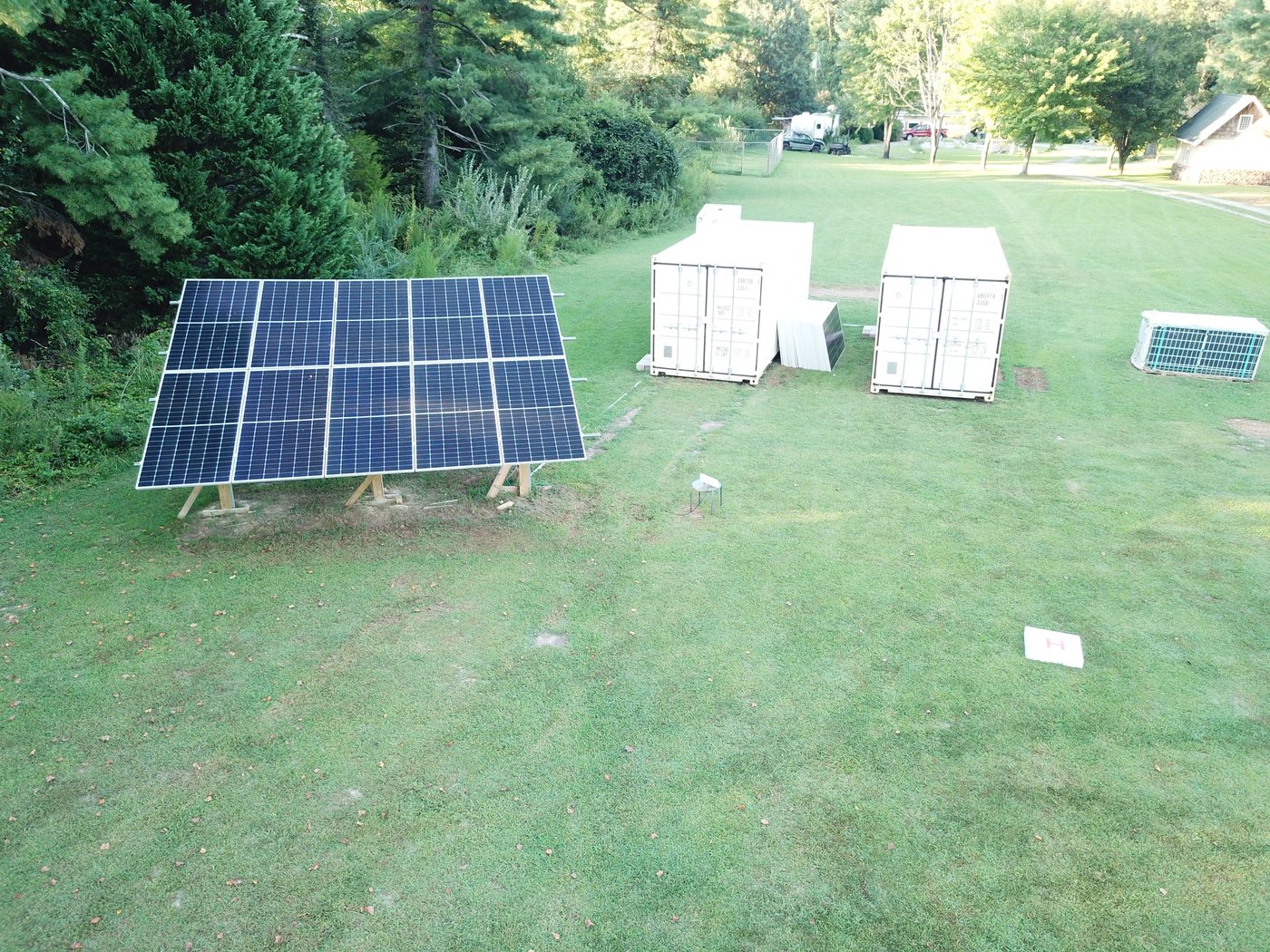
Aerial view of the Eclipse proving ground in Gloucester, Virginia
DemonstratedPrototype 1 on the Gloucester, VA proving ground — real, under test.
240kW
Power layer, one node
~1.9MWh
Energy storage
~57kW
Sustained 24/7
~30hr
Ride-through, no sun
Planned developmentPlanned node — notional; enough to carry a shelter, clinic, water plant or communications site. Prototype 1 today: 48 kWh installed and under test.
Eclipse Power & Infrastructure, Inc. · SDVOSB and WOSB certifications in progress
01 — Why

Centralized grids fail all at once.

Islands, territories and coastal regions share a pattern: abundant sun, aging centralized infrastructure, and exposure to hurricanes, earthquakes and floods. When one plant or one transmission corridor goes down, the outage cascades — and restoration cannot begin until the weather clears and crews can safely reach the damage. Hospitals, water systems, shelters and emergency communications cannot wait for that.

Puerto Rico · January 2020 · Earthquake

One plant, one island, all dark.

A magnitude-6.4 earthquake on 7 January damaged the Costa Sur power plant — roughly a fifth of the island’s generation. Though the damage was local to the southern coast, the loss cascaded into a near-island-wide blackout for more than three million people. The grid had never fully recovered from Hurricane Maria in 2017, and continuing aftershocks forced plants to evacuate their crews, leaving hundreds of thousands without power and running water for days.

~1/5
of generation at one plant
Days
without power & water
Hawaiʻi · Aug–Sep 2026 · Two hurricanes in four weeks

Restoration stops when the weather turns.

Hurricane Lala knocked out power to roughly 197,000 customers statewide at its peak, with gusts near 90 mph toppling transmission lines. Crews were ordered off the roads until conditions eased, and some outages were projected to last months. Four weeks later Hurricane Lowell left about three-quarters of Kauaʻi in the dark and thousands more out on Oʻahu, with restoration across 1,500 miles of line expected to run well into the following week.

~197,000
customers out · Lala, peak
~75%
of Kauaʻi dark · Lowell
Sunny, isolated, aging grids are the most exposed — and the best suited to distributed solar-plus-storage that keeps critical loads alive while the grid is rebuilt.
Sources: Hawaiian Electric and Kauaʻi Island Utility Cooperative outage reporting; Hawaii News Now, Honolulu Star-Advertiser and Honolulu Civil Beat coverage, Aug–Sep 2026. Puerto Rico figures from public reporting on the January 2020 earthquake sequence.

One container. Every service a site needs.

The Expeditionary Containerized Microgrid (ECM) is delivered as modular, containerized elements that combine into a node sized to the site — a shelter, a clinic, a water plant, a base — and replicated without bespoke redesign.

POWER MODULE

Generation, storage, controls

Photovoltaic and/or alternative generation, battery energy storage, hybrid generator integration, and microgrid controls. Source-agnostic interfaces let wind, fuel-cell and future generation be added without redesign of the core.

THERMAL MODULE

Environmental control

Heat management and environmental control for supported facilities and equipment — shelters, clinics, cold chain — housed in its own conditioned container.

WATER MODULE · OPTIONAL

Production and storage

Water production and storage at the node, so a site is not waiting on a second line of resupply when the grid and the mains are both down.

COMMUNICATIONS · OPTIONAL

Connectivity for responders

Power and housing for communications, sensing and edge-processing equipment co-located at the node, restoring connectivity where the network has failed.

MONITORING & MANAGEMENT CORE

EIM²S — the durable asset

The software that meters, dispatches and manages the node. Retained across hardware refresh and scaling from a single node to a regional fleet, it is the same core that runs our commercial systems today.

02 — Operations Model

Managed remotely.
Runs on its own when it must.

Every fielded node is monitored, managed, optimized and sustained from a CONUS operations center over a private, encrypted global management network. In a disaster that is the mode that matters: if the network is lost, an on-node emergency local-control mode keeps power flowing to designated critical loads and reconnects automatically when connectivity returns.

Nodes operate semi-autonomously and recover from faults without an operator. They are maintained on site by a thin local team through modular replacement, with deep maintenance by reachback — so a node keeps running when the people who normally service it cannot get there.

Planned developmentStorm stow — self-protecting in bad weather. Planned development: the node will detect extreme weather and high winds on its own, stow the generation array, carry critical loads on storage and generator through the storm, and redeploy the array on all-clear — exactly the window in which utility crews are ordered off the roads.

Concept renderingSelf-protecting in bad weather — the array stows itself as the storm arrives. Planned development.
Concept renderingAutonomous and unattended operation — aspirational, planned development.

What is demonstrated today.

Everything below is real, measured and dated. Planned-development and concept material elsewhere on this page is labeled as such.

Demonstrated

Prototype 1 — Gloucester, Virginia

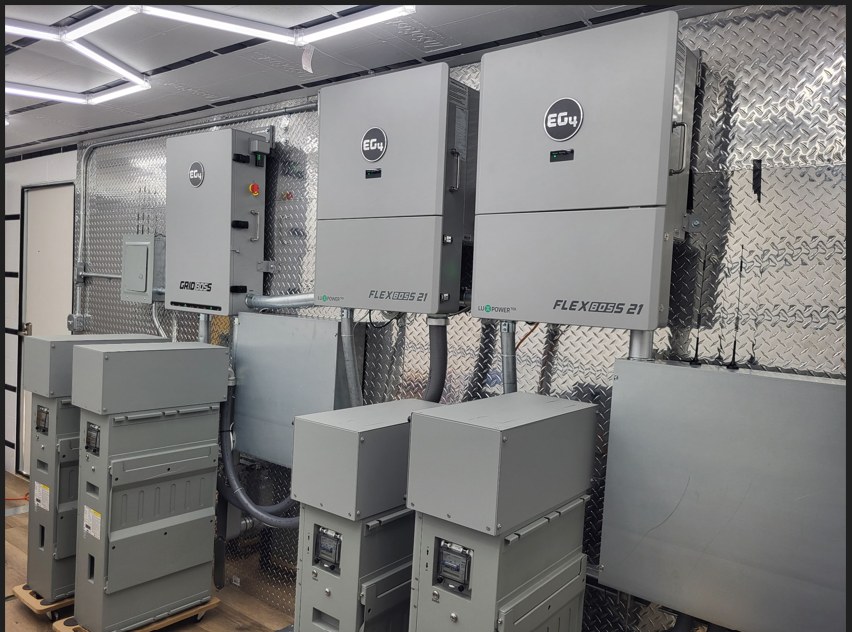
A containerized power node with an EG4 48 kWh system installed and under test on our five-acre proving ground, feeding a ground-mounted array. TRL 6 achieved — Stage 1 declared August 2026, Stage 2 declared September 2026. The full build-out design is 192 kWh; the interface hardware is sized for it from day one.

Containerized node · EG4 GridBOSS + dual FlexBOSS 21 · container envelope thermally characterized
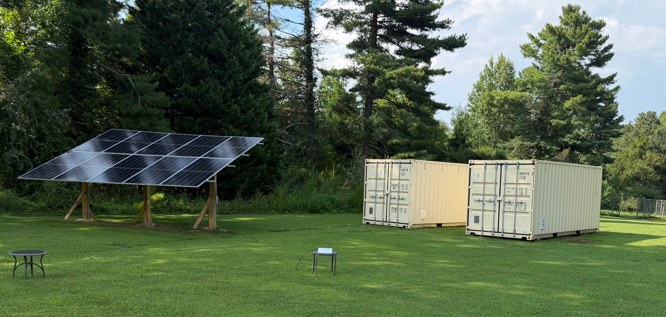
Prototype 1 exterior: array and containers at GloucesterPrototype 1 interior: EG4 GridBOSS and FlexBOSS inverters
Demonstrated

Remote inspection when crews can’t get there

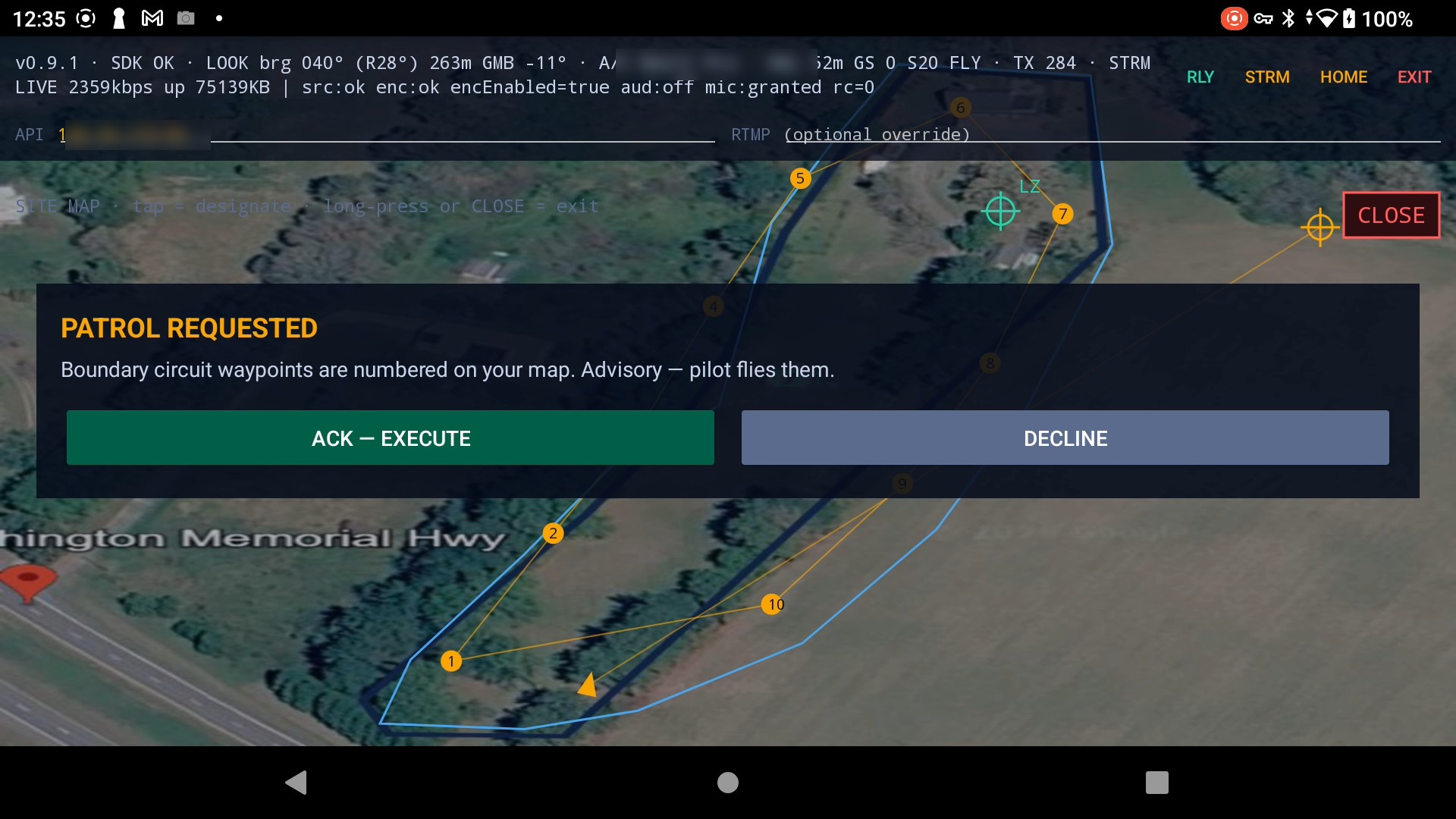
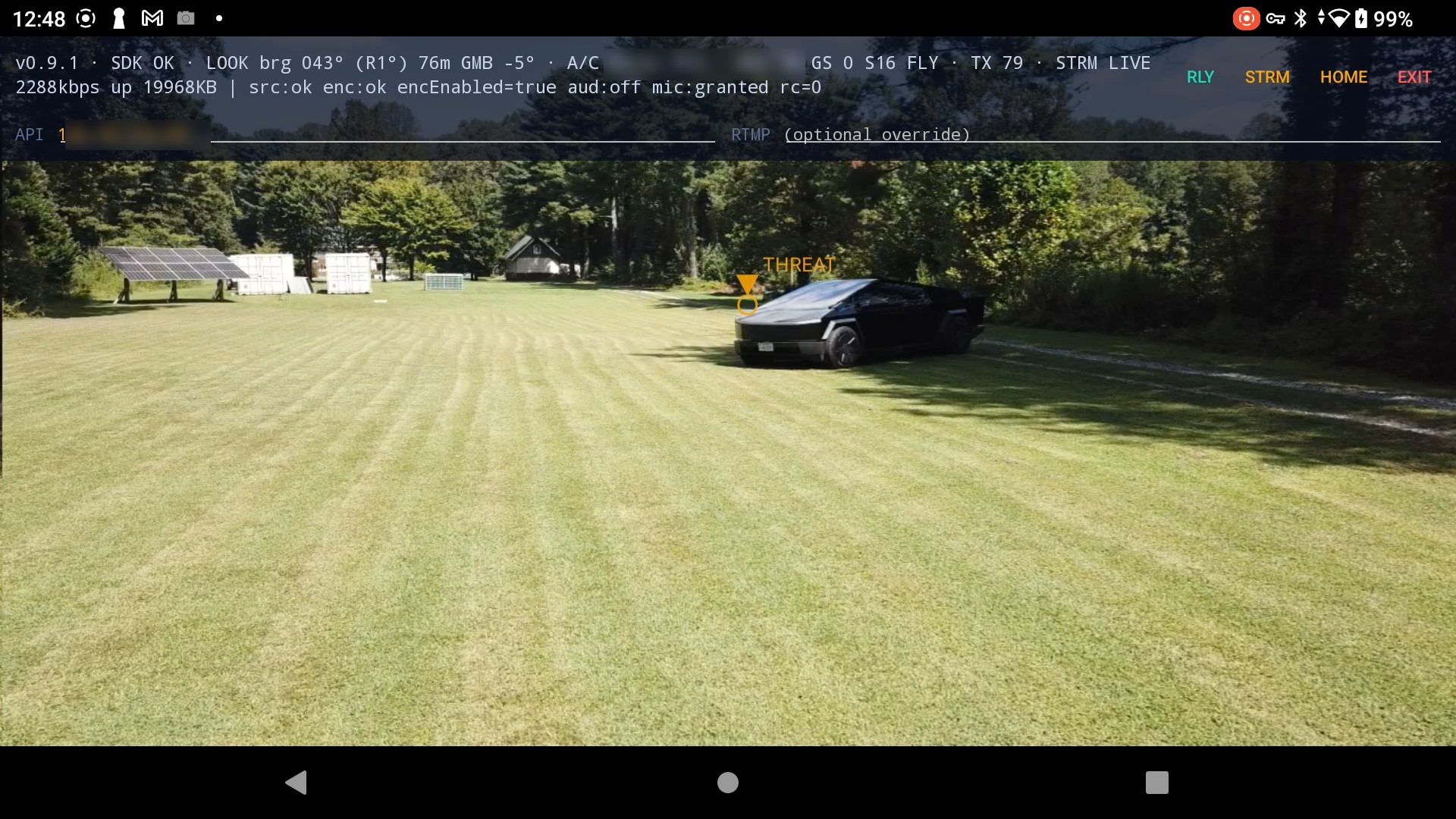
An operator in the United Kingdom tasked an aircraft over the Gloucester site — more than 3,000 miles away — to survey it and flag anomalies, with encrypted live video carried beyond line of sight over a satellite link and a private overlay network. A local safety pilot held flight authority throughout: the remote operator requests a survey, the on-site pilot acknowledges and flies it. The same approach lets a site be assessed and its array inspected after a storm, before anyone drives in.

Advisory tasking only · no software flight commands · demonstrated on a commercial airframe; an NDAA-compliant airframe is the fielding path
Ground station: advisory survey taskingLive encrypted video from the aircraft
Demonstrated

Rapid capability insertion

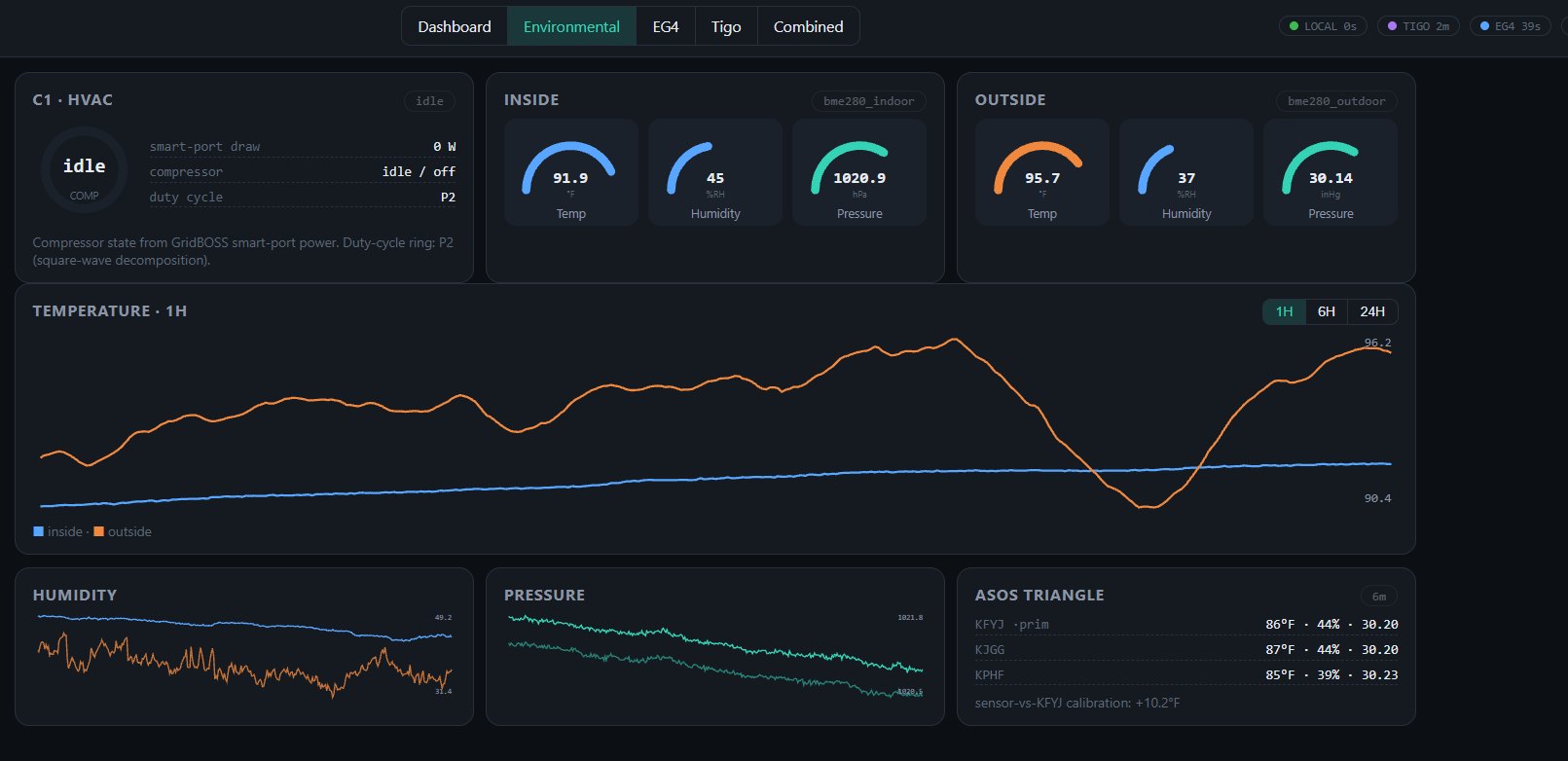
A new sensing modality — live aircraft telemetry and video — was integrated end-to-end into EIM²S on the field network with a real aircraft, concept to live video in 16 days, reusing the existing architecture unchanged and without disturbing the production nodes. The same platform meters and manages the power system, environmental envelopes and cameras from a single operational view, reachable anywhere over an encrypted overlay.

Time-to-new-capability is a measured property of the architecture, not a projection
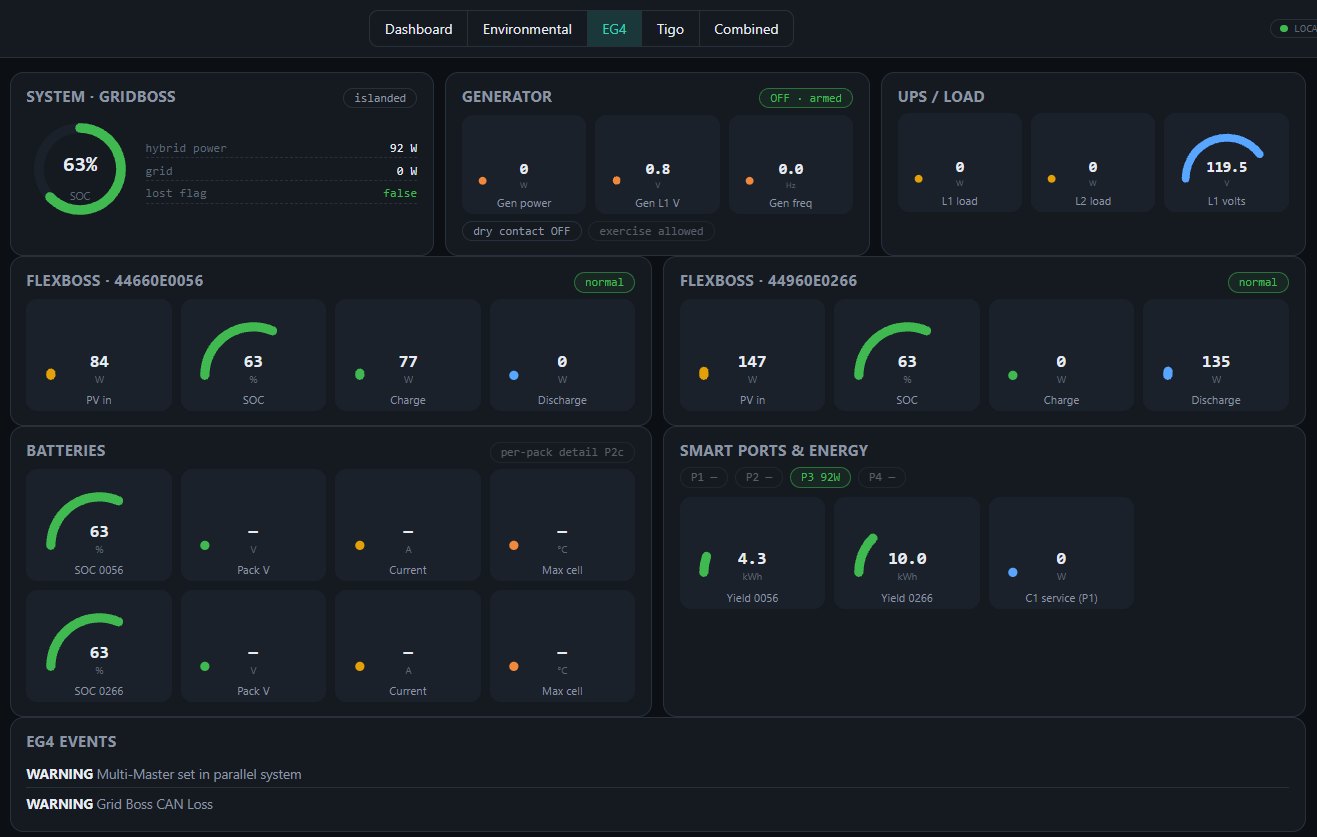
EIM2S environmental dashboardEIM2S EG4 power management dashboard

Deployable in 30 days. By road, sea or air.

ECM ships in standard 20-ft ISO containers — transportable by any means that moves a container — and is designed for scalable minimum-notice deployment in 30 days or less, from a single node to a regional fleet, on a commercial production and logistics base.

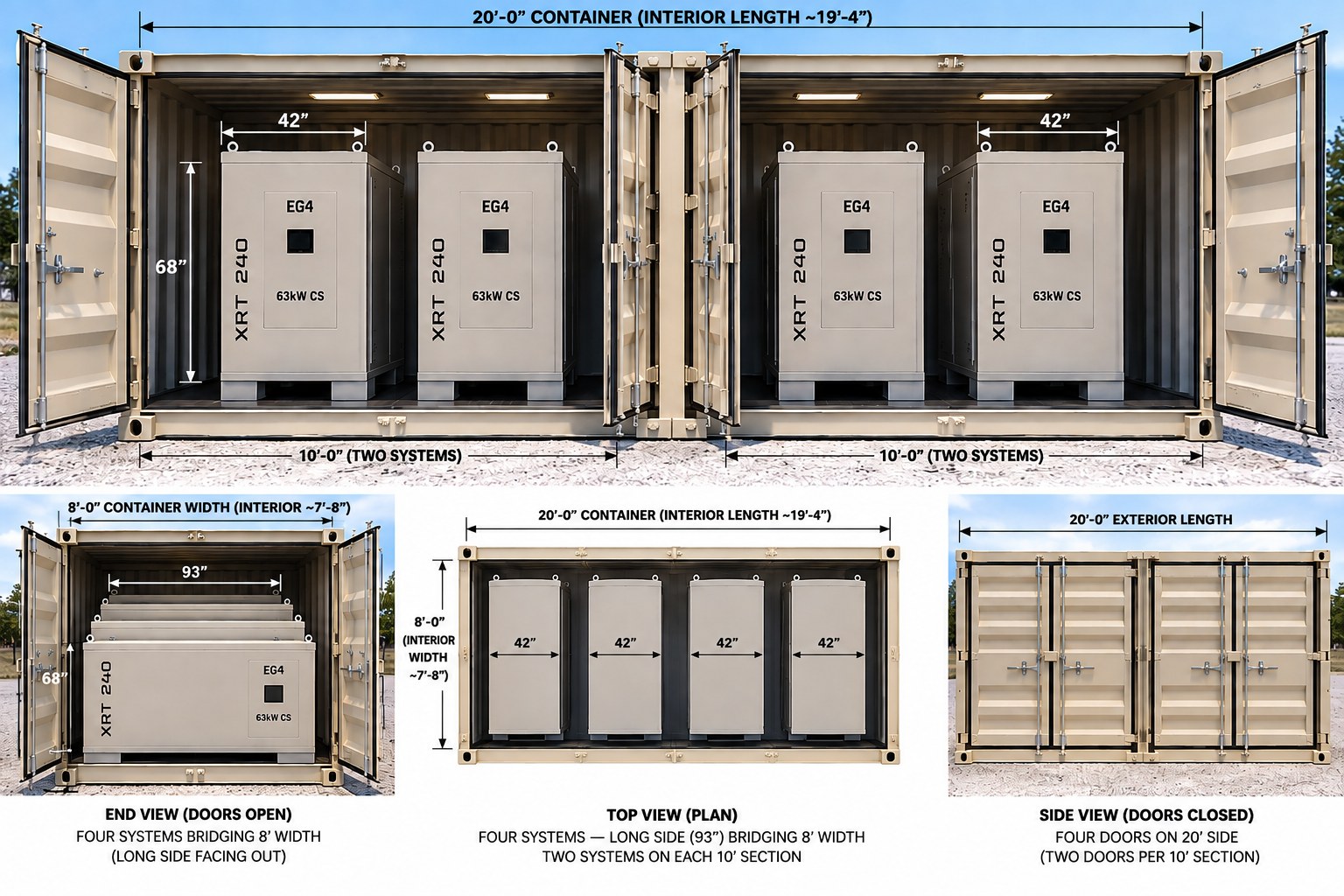
NotionalContainerized power layer — one 20-ft node
Notional layout of four EG4 XRT 240 systems in a 20-ft ISO container
Notional layout — four EG4 XRT 240 (63 kW) systems in a single 20-ft ISO container, two per 10-ft section, four doors on the 20' side. Illustrative packaging; not a released configuration.
Storm
Hardened and self-protecting

Containerized and anchored today; a self-stowing array that rides out high winds on storage and generator is planned development.

Cyber
Secure baseline

Local-first data plane, encrypted private management network, no exposure to the public internet.

Supply chain
Domestic and clean

Commercial and industrial standards throughout, a domestic supply-chain posture, and an NDAA-compliant UAS path.

Hardening options
HEMP-aware baseline

The commercial baseline is HEMP-aware, with an upgrade path to HEMP-capable for installations that require it — planned development, without redesign of the core.

Same container. Same software. Same supply chain.

One node type serves many missions, and the same architecture serves residential and commercial customers — every mission strengthens the production base the others ride on.

Disaster relief & DSCAIslands & territoriesHospitals, shelters & EOCsWater productionInstallation backup powerCommunications & radar sitesForward medicalResidential & commercial microgrids
Also — Defense & Expeditionary

The same node deploys with forces.

For distributed and expeditionary basing, the identical container, software and supply chain deliver assured power at the operational edge and reduce the bulk-fuel sustainment tail. Details on request under the appropriate distribution.

Request the expeditionary brief →

Concept renderingAirlift deployment — planned development.
Also — HEMP Resilience

Designed in, not bolted on.

A high-altitude electromagnetic pulse can disable unhardened power, communications and control electronics across a wide area. The commercial ECM baseline is HEMP-aware — a zonal architecture with shielding, filtering and isolation at the container boundary — with an engineered upgrade path to HEMP-capable for installations that require it, without redesign of the core.

Planned developmentThe HEMP-capable configuration is planned development — an aspirational upgrade path not yet tested to a HEMP standard. The vignette illustrates the intent, not a fielded capability.

ConceptHEMP resilience vignette — planned development. Press play · sound on.
03 — Contact

Ready when the grid isn’t.

Eclipse Power & Infrastructure, Inc. is a small business with SDVOSB and WOSB certification in progress. We engage directly with federal, state and territorial emergency-management and installation-energy offices, and through SBIR/STTR and Phase III pathways.

info@eclipsepower.net · Newport News, Virginia